
Goal: provide a practical guide to choosing wood species, building a mandolin, and understanding its sound. This article explains how materials and shape affect the instrument’s projection, clarity, and longevity.
We place the subject in the wider world of instrument making, drawing comparisons with guitars to clarify the choice of woods such as spruce, mahogany, and rosewood. Innovation and tradition meet: thermally modified woods, biodegradable composites, and nondestructive grading now help makers choose materials.
A concrete example: in a project to build an eight-string teardrop mandolin, the scale length was reduced from 375 to 365 mm, with a 15-foot radius and thicknesses close to 2 mm. These figures reflect a balance between projection and strength.
What this guide offers: a way to turn common questions about fingerboard radius, body depth, and break angle into clear, repeatable decisions for building and setting up instruments. To learn more, see the Mandolin page.
Why wood shapes the mandolin’s voice
The woods chosen for the body determine how each note travels and how it is coloured in the surrounding space. Density (ρ), Young’s modulus (E), the Q factor, wave speed (c), and acoustic impedance (ρc) influence projection, tone, and resonance.
A good balance between mass and stiffness converts string energy into useful sound. Spruce, often chosen for the soundboard, has a high stiffness-to-weight ratio and a favourable c/ρ value for sound radiation.
Making music calls for choosing the wood for each part carefully so that projection and sustain work together. Guitars and other instruments illustrate these principles; the mandolin concentrates them in a small, highly responsive body.
- Vibrational response: affects perceived tone, clarity, and dynamics.
- Compatibility: the soundboard should work with the back and sides to limit energy loss.
- Research: physical properties provide objective guidance when selecting woods.
Instrument making combines tradition and innovation. Understanding each wood’s properties reduces uncertainty in the workshop and makes an instrument’s voice more predictable.
Properties of instrument woods and their acoustic impact
A wood’s mechanical properties guide projection, tone, and sustain. These values help explain how a board turns vibration into musical colour.

Density, Young’s modulus, and Q factor
Density (ρ) and Young’s modulus (E) affect the speed and amplitude of waves. Low density combined with a high Young’s modulus promotes good projection without making the tone heavy.
The Q factor measures how long vibrations persist: a high Q factor can provide greater clarity and sustain, which is useful in responsive instruments.
Wave speed, impedance, and transmission properties
Wave speed (c) and impedance (ρc) determine how energy travels through a piece of wood. The c/ρ and cQ values serve as indicators of radiation and transmission.
- c/ρ: indicates a soundboard’s potential to radiate sound.
- cQ: combines wave speed and the persistence of vibrations to compare materials.
Common woods: uses and tonal character
Spruce remains a standard choice for soundboards: it combines low density, high stiffness, and an excellent response. Mahogany and rosewood are often chosen for backs and sides. Their greater density encourages internal reflection and enriches overtones, as has been well documented for classical guitars.
To pair a soundboard and back effectively, choose a soundboard with a high Young’s modulus and moderate density, and a slightly denser back to support a rich range of overtones. This example can simplify wood selection in the workshop.
Mandolin making: understanding the woods and soundboard
To achieve a clear, projecting voice, the vibrating surface calls for careful technical choices.
Spruce for the soundboard: low density, high stiffness, and sound radiation
Spruce remains popular for its stiffness-to-weight ratio. It produces a crisp attack, radiates sound effectively, and offers a good balance between low and high notes. This wood supports the quality and projection of instruments.
Thickness, arching, and radius (about 15 feet)
A thickness of around 2 mm is a practical starting point. It should be adjusted to suit the wood’s density and the shape of the arch.
A radius of around 15 feet increases strength under string tension and changes the distribution of vibrational modes. The result is better responsiveness and greater mechanical stability.
Bracing, distribution of vibrations, and finishes
The position and mass of the braces direct energy toward the active area. Careful assembly and scraper work help preserve the acoustic balance.
An overly thick finish can dampen the sound; a thin finish preserves its richness and projection.
| Parameter | Effect | Recommendation |
|---|---|---|
| Wood species | Sound radiation and attack | Spruce for the soundboard |
| Thickness | Response and strength | About 2 mm, adjusted for density |
| Arch (radius) | Stiffness and vibrational modes | About 15 feet for a teardrop mandolin |
| Bracing | Clarity, volume, and stability | Precise placement and controlled mass |
Back, sides, neck, fingerboard, and bridge: wood choices and acoustic roles
Each part—the back, sides, and neck—plays a distinct role in tone and sustain. The back and sides enrich the overtones, while the neck and fingerboard transmit energy toward the body.
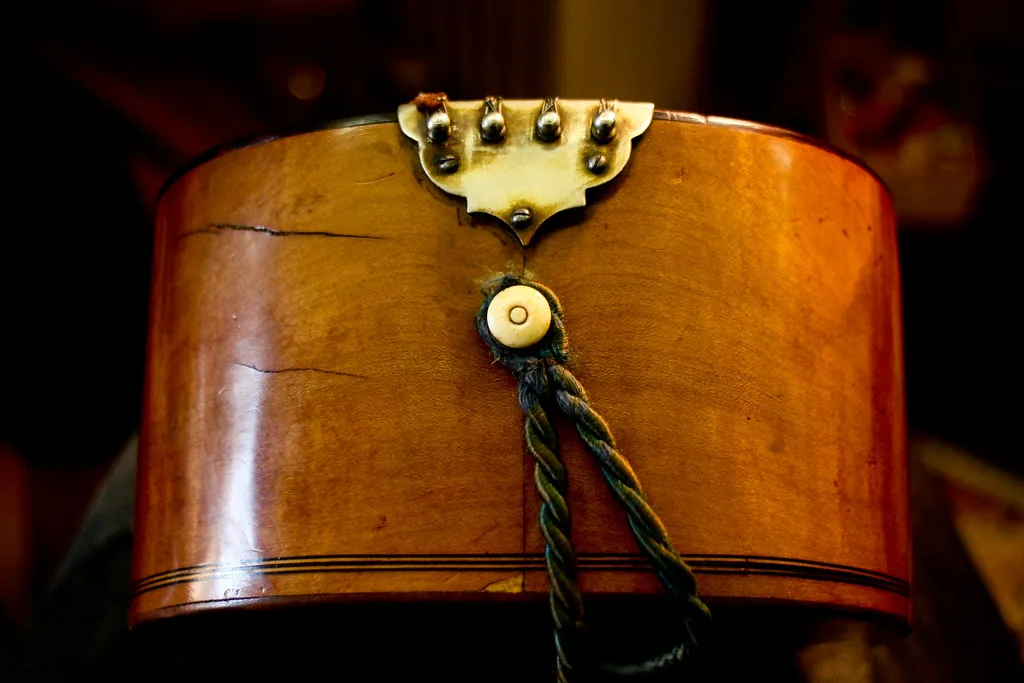
Back and sides: reflection, depth, and local alternatives
Rosewood brings rich overtones and sustain. Mahogany provides warmth and responsiveness.
Walnut, ash, and pearwood are excellent local alternatives. They balance internal reflection against weight. The back works with the soundboard to shape the body’s vibrational modes and its acoustic ‘breathing.’
Neck, fingerboard, and bridge: transmission and stability
The neck must be stable and stiff along its length. Straight-grained wood limits distortion and helps transmit energy to the body.
The fingerboard needs a hard wood that resists wear and keeps the frets level.
The bridge controls coupling impedance: in the example discussed, a mahogany bridge with a bone saddle improves attack and precision.
| Part | Effect | Recommendation |
|---|---|---|
| Back | Depth and sustain | Rosewood for richness, mahogany for warmth |
| Sides | Internal reflection | Match them to the back; alternatives include walnut, ash, and pearwood |
| Neck and fingerboard | Stability and playability | Hard, straight-grained wood; a dense fingerboard for the frets |
| Bridge | Impedance between strings and soundboard | Mahogany and a bone saddle to balance attack and sustain |
Keep the parts compatible: thoughtful wood selection improves an instrument’s quality and reliability. For more on choosing woods, consult this resource on woods for instruments.
Key geometry and setup choices for a responsive mandolin
Dimensions and angles define the dynamic response and playing comfort.
Scale length, angle, and depth
Scale length of 365 to 375 mm: reducing the scale length to 365 mm lowers string tension and makes playing easier for the fretting hand. At 375 mm, the attack is more pronounced, but tension increases.
Break angle of around 16°: this angle applies sufficient downward pressure to the bridge. It provides good coupling between the strings and soundboard without overloading the arch.
Body depth of around 6 cm: this affects air volume and resonance modes. A deeper body strengthens the bass; a shallower body favours midrange projection.
Fingerboard, shape, and overall balance
Fingerboard radius: flat or moderate, depending on playing style. Accurate fret levelling remains essential to prevent buzzing and ensure comfortable playing.
“Treat every parameter as part of a system; changing one setting in isolation can upset the whole.”
Tolerances and procedure
- Neck and bridge alignment: ± 1 mm.
- Recommended action height: adjust to suit the strings and playing style.
- Record measurements during prototyping for every setup decision.
| Parameter | Effect | Tolerance |
|---|---|---|
| Scale length | Tension and comfort | 365 to 375 mm |
| Break angle | String pressure | About 16° |
| Depth | Resonance modes and volume | About 6 cm |
| Alignment | Clean playing | ± 1 mm |
Construction, assembly, and thicknesses: from theory to the workshop
Moving from theory to the workbench quickly reveals the trade-offs between thickness, stiffness, and the body’s longevity. During construction, a measurement must be adjusted to the wood’s density and the instrument’s intended use.

Typical thicknesses: examples and limits
About 2 mm remains a starting point for the soundboard, back, and sides.
Adjust this value: denser wood → increase the thickness; lighter wood → reduce it to preserve responsiveness.
Joints, gluing, and bracing patterns
Aim for precise joints and consistent grain orientation between parts. Good gluing ensures long-term stability.
- Suitable glue: choose strength and flexibility appropriate to the stresses at each joint.
- Apply even clamping pressure and control humidity and temperature.
- Bracing: use as little mass as practical, positioned to support the active area without weighing it down.
Arching with a radius dish and controlling distortion
A radius dish of around 15 feet produces an even arch. This shape reduces concentrations of stress and limits distortion under string tension.
“Measure, test, adjust, document, repeat”: a workshop research method for achieving consistent quality.
| Element | Recommendation | Effect |
|---|---|---|
| Soundboards | About 2 mm, adjusted as needed | Response and projection |
| Back | About 2 mm, sometimes more | Depth and sustain |
| Sides | About 1.8 to 2.2 mm | Sideways stiffness |
| Bracing | Precise placement | Body durability |
Practical conclusion: check each assembly step to avoid costly corrections after construction. Applied research in the workshop produces more reliable, better-tuned instruments.
Innovation and sustainability: alternatives and wood grading
Workshops now use nondestructive grading methods to make better use of every board.
Thermally modified woods and biodegradable composites
Thermally modified woods: heating reduces moisture absorption and improves dimensional stability. This helps them withstand changes in humidity and may produce a drier tone.
Take care: treatment can reduce some overtones; the maker must adjust thickness and bracing.
The BING method and nondestructive testing
BING grades pieces by their vibrational properties without damaging them. This nondestructive testing system improves yield by identifying boards with strong potential for responsive instruments.
Grading and making use of imperfect wood
Using pieces with visible marks supports more ethical sourcing. Such wood can be reserved for the back, sides, or less critical body parts.
Research shows that a selection system based on objective criteria reduces waste while maintaining the finished instrument’s quality.
“Think about the whole life cycle: from forest to workshop, every choice matters for an instrument’s sustainability and voice.”
| Solution | Benefit | Precaution |
|---|---|---|
| Thermally modified woods | Dimensional stability and lower moisture absorption | Possible reduction in overtones; adjust thickness |
| Biodegradable composites | Lower environmental footprint and purpose-designed properties | Test long-term durability; use for less critical parts |
| BING and nondestructive testing | Objective grading and better yield | Requires calibration; complements the maker’s expertise |
To explore modern practices and workshop examples, read this resource on selecting and working wood for instrument making: selection and innovation.
Case study: restoring a mandolin, from body to bridge
The instrument: an old mandolin arrived at the workshop with a back split into three pieces, damage to the soundboard, and a buzz near the 10th fret.
Replacing and reinforcing the back
Diagnosis: a badly cracked back, a partly detached rosette, and a worn edge on the fingerboard extension. The back also showed significant distortion.
Repair: a new quarter-sawn birch back was bookmatched and assembled. A joint reinforcement was glued in place to provide strength and keep the back flat.
Stabilising the soundboard
The braces were reglued, and wood splints and cleats were placed beneath each crack. This method protects the active surface without adding excessive weight.
Finish, bridge, and setup
A ‘faux mahogany’ stain was applied to respect the original appearance. A new mahogany bridge with a bone saddle was adjusted for intonation and action height.
The strings were brought back up to tension with a Dreima tailpiece, and fret levels and flatness were checked. A targeted adjustment around the 10th fret eliminated the buzz.
| Stage | Action | Result |
|---|---|---|
| Back | Bookmatched birch and joint reinforcement | Structural strength and a consistent appearance |
| Soundboard | Reglued braces, wood splints, and cleats | Stabilised cracks and preserved sound |
| Bridge | Mahogany, bone saddle, and adjustment | Improved attack and suitable action height |
| Tests | String tension, flatness, and fret adjustment | Buzz eliminated and sound output restored |
Lesson: good wood choices and precise workmanship prevent problems from returning and help maintain sound output over time.
Conclusion
This overview shows that careful choices of materials and geometry underpin a consistent sound.
Key working values are a scale length of 365 to 375 mm, a radius of about 15 feet, thicknesses around 2 mm, a break angle of about 16°, and a body depth of about 6 cm. These figures guide projects and prototypes.
Spruce remains a dependable choice for the vibrating surface. Rosewood and mahogany shape internal resonance and enrich the overtones.
Research, nondestructive grading (BING), and treatments such as thermal modification and composites make material choices and quality more reliable. In the workshop: measure, listen, adjust, and document.
Modern instrument makers have a wide range of technical options. Keep exploring tradition and innovation to create instruments that inspire music for years to come.