
This guide offers a clear and lively overview of the mandolin, a small, short-necked lute that traveled from Italy to Mediterranean and North American stages.
We begin by describing this plucked string instrument, its typical shape (rounded body, pierced soundboard, fretted neck) and its dimensions.
The article follows the major periods: its origins, its rise in eighteenth-century Naples, its golden age from the late nineteenth to the early twentieth century, and its subsequent decline and revival, particularly in bluegrass.
Here you will find information on instrument making, the mandolin family (mandola, mandocello and regional variants), and the developments that changed its sound and projection.
To learn more about instrument-making traditions and construction, see this specialist page on the mandolin maker.
The origins of this plucked string instrument
As early as the late thirteenth century, the gittern appeared as a popular small lute. Its body was often carved from a single block of wood, with a sickle-shaped pegbox.
It was played with a bird feather, producing a lively, highly articulated sound. The gittern was found at every level of society: at court, in the street and in taverns.
From French Baroque music to the mandore
Arriving from Navarre around 1570, the mandore took root in France. Its body could be carved from a single block or built from assembled wooden ribs.
It had four single strings tuned in fourths and fifths and served a refined repertoire exemplified by François de Chancy.
The Italian transformation: the Lombard mandolino
In Italy, the mandore was heard at a Medici wedding as early as 1589. It soon developed into the mandola and then the Lombard mandolino.
Double courses, tuning in fourths and thirds, and the addition of fifth and sixth strings in the early eighteenth century expanded its range.
- Carlo Arrigoni wrote for the instrument and basso continuo.
- Francesco Redi mentioned the “mandolino” as early as 1685, attesting to the use of the name.
The Neapolitan mandolin: the classical rise of a small lute
In the second half of the eighteenth century, the Neapolitan mandolin acquired its established tuning and shape. It is tuned in fifths, like the violin (G, D, A, E), making it easier to transcribe works and encouraging violinists to adopt it.
The standard model has four courses of paired metal strings. Playing with a plectrum—first a feather, then a harder material—allows a crisp attack and rapid articulation.
Its construction is recognizable by its teardrop-shaped soundboard, sometimes bent at the bridge, its circular soundhole and its ribbed, rounded back. A protective plate near the soundhole prevents wear from the plectrum.
- Clarity and projection from the paired strings, ideal for ornamentation and tremolo.
- A Neapolitan repertoire established around 1760 (Majo, Barbella, Cecere).
- Spread through teaching methods and virtuosos such as Gabriele Leone.
| Feature | Description | Effect on sound |
|---|---|---|
| Tuning | Fifths (G, D, A, E) | Makes violin repertoire easier to adapt |
| Strings | Four double courses of metal strings | Bright projection and short sustain |
| Construction | Teardrop-shaped soundboard, soundhole, rounded back | Quick response and rich tone |
Sound-producing structure: soundboard, body and neck
An instrument’s sound depends on the balance between its soundboard, body and neck. A typical mandolin measures 70 to 75 cm and combines a thin soundboard with an opening, a resonant body and a short neck to produce its distinctive tone.
The soundboard and its openings
The soundboard acts like a membrane: its bracing and thickness determine projection and tone color. A central oval soundhole tends to produce a warm, focused tone. F-holes, inherited from American designs, provide a different balance in the high frequencies.
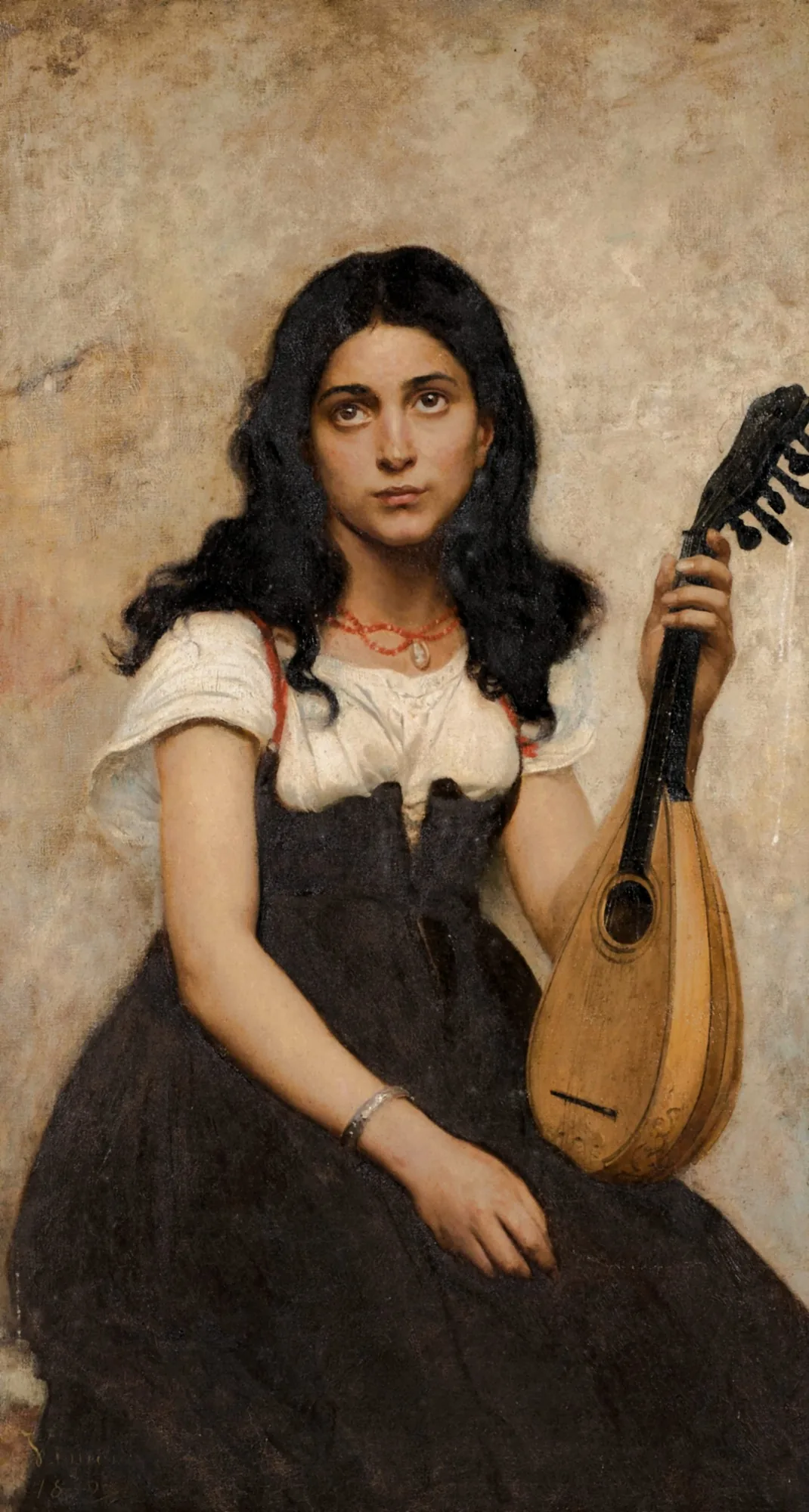
Body and materials
A ribbed, rounded back offers a quick, focused response, while a flat or slightly arched back disperses sound differently. The choice of wood (spruce, maple) and laminated construction influence resonance and attack.
Neck, bridge and peghead
The narrow short neck, fitted with fine frets, supports fast playing and even tremolo. A flat bridge, or an adjustable one on some models, affects intonation and makes it easier to accommodate modern strings. The peghead helps keep the instrument in tune.
- Different openings—elongated oval, asymmetrical or triangular—shape the dynamics.
- Innovations include Vega’s “cylindrical” back (1913), the German zero fret and Bohmann’s sympathetic strings.
To compare construction details and help date an instrument, examine the protective plate near the soundhole and any bend in the soundboard. For a closer look, consult this instrument-making reference.
The mandolin family and its variants around the world
Across Europe and the New World, different shapes and tunings gave rise to distinct families.
Milanese, Genoese and Florentine
The Milanese mandolin (mandurina) has six courses of gut strings tuned in fourths with one third (G2, B2, E3, A3, D4, G4). It is played with the fingers, unlike the Neapolitan mandolin, which is played with a plectrum on metal strings.
The Genoese variant derives from this model, with a narrower neck and five or six single strings. The Florentine variant has a smaller body and a longer neck; it may have five double courses or four single strings.
An extended family
Since the eighteenth century, the family has included the soprano mandolin, the alto (mandola, tuned C, G, D, A), the mandocello (tuned like a cello, an octave below the alto) and the bass (E, A, D, G).
Sopranino and octave models extend the range further, adding balance and tonal color to a quartet.
Regional variants and innovations
Around the world, the Brazilian bandolim (with a circular soundboard and flat back) plays a part in choro. The Irish mandolin favors flat backs and soundboards for folk music. The Algerian snitra, with its flat body and long neck, supports chaâbi and Kabyle music.
Between 1890 and 1930, the mandolinetto, the Wappen and the banjoline appeared; later, electric models broadened the modern range of sounds.
To match an instrument to your repertoire, consider the type you want: attack, projection and neck comfort can guide your decision. For folk music, see our page on emblematic instruments.
Playing techniques and plectrums: from staccato to tremolo
Mastering the plectrum turns a melody into expressive musical speech. Held between the thumb and index finger, it allows both crisp staccato and continuous tremolo.
Plectrums and materials: historically, players used feathers (crow or ostrich) with gut strings. For metal strings, they favored tortoiseshell, ivory or bone, followed by modern materials offering projection and durability.
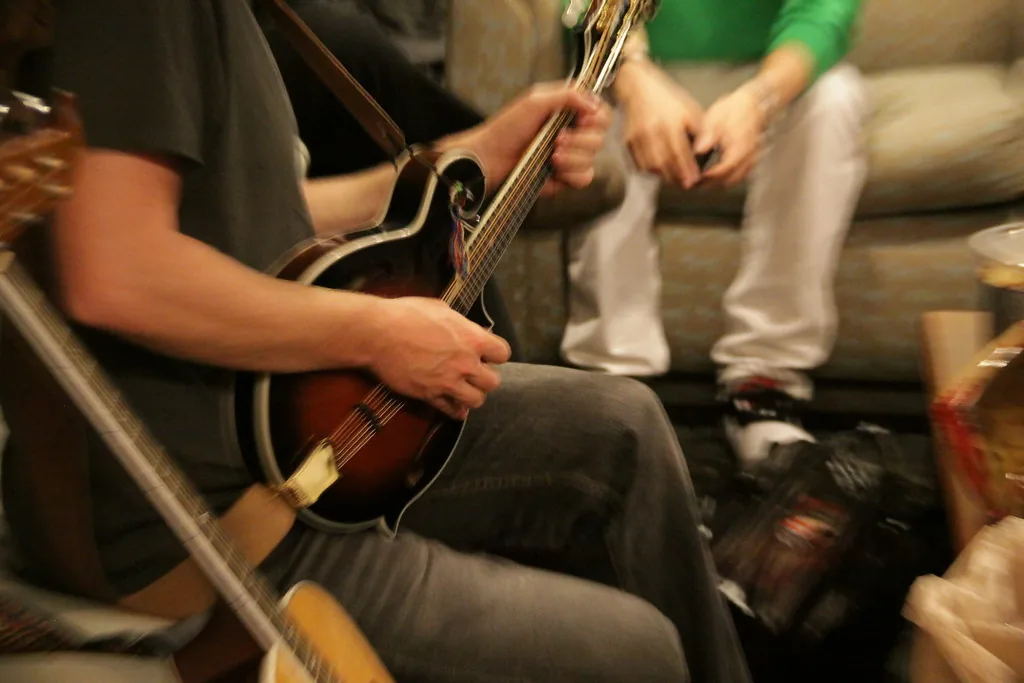
Principal phrasing and techniques
Short, detached picking gives rhythmic accompaniment a lively staccato. Alternate picking speeds up scales and crosspicking. Tremolo, the equivalent of a long bow stroke, creates sustained, singing notes.
Muted pizzicato is produced by resting the edge of the hand on the bridge. It creates a soft, almost percussive sound that adds tonal variety.
Quick comparisons: guitar, violin and mandolin
The mandolin’s small body and short neck distinguish it from the guitar. Its strings are paired in courses (eight strings), compared with six on a guitar. Its sound is brighter and more crystalline.
Tuning “like a violin” makes it easier to transfer repertoire. Plectrum tremolo takes the place of the bow for long sustained notes. Each instrument calls for particular shapes and styles.
| Element | Technical effect | Practical advice |
|---|---|---|
| Plectrum (feather or modern material) | Soft tone or greater projection | Choose according to the repertoire and strings |
| Alternate picking | Speed and articulation | Practice slowly, then increase the tempo |
| Tremolo | Extended legato | Practice the rhythm with a metronome |
Choosing a pick: its thickness and stiffness determine the attack. Modern materials suit crosspicking and the chop. For advice on finding an instrument that suits your style, see our guide to choosing a mandolin.
Repertoire and composers: from Vivaldi to the twentieth-century orchestra
Its tone, both bright and singing, has appealed to composers and musicians in several eras.
In the Baroque era, Vivaldi’s concertos RV 425 (mandolin, strings and continuo) and RV 532 (two mandolins) highlight the instrument’s attack and delicacy. Mozart included its voice in the serenade in Don Giovanni. Beethoven left four short pieces (WoO 43a, 43b, 44a and 44b), showing his interest in the instrument.
Instructional methods helped establish its technique: Leone, Denis, Fouchetti, Corrette and Bortolazzi formed a tradition that still serves performers.
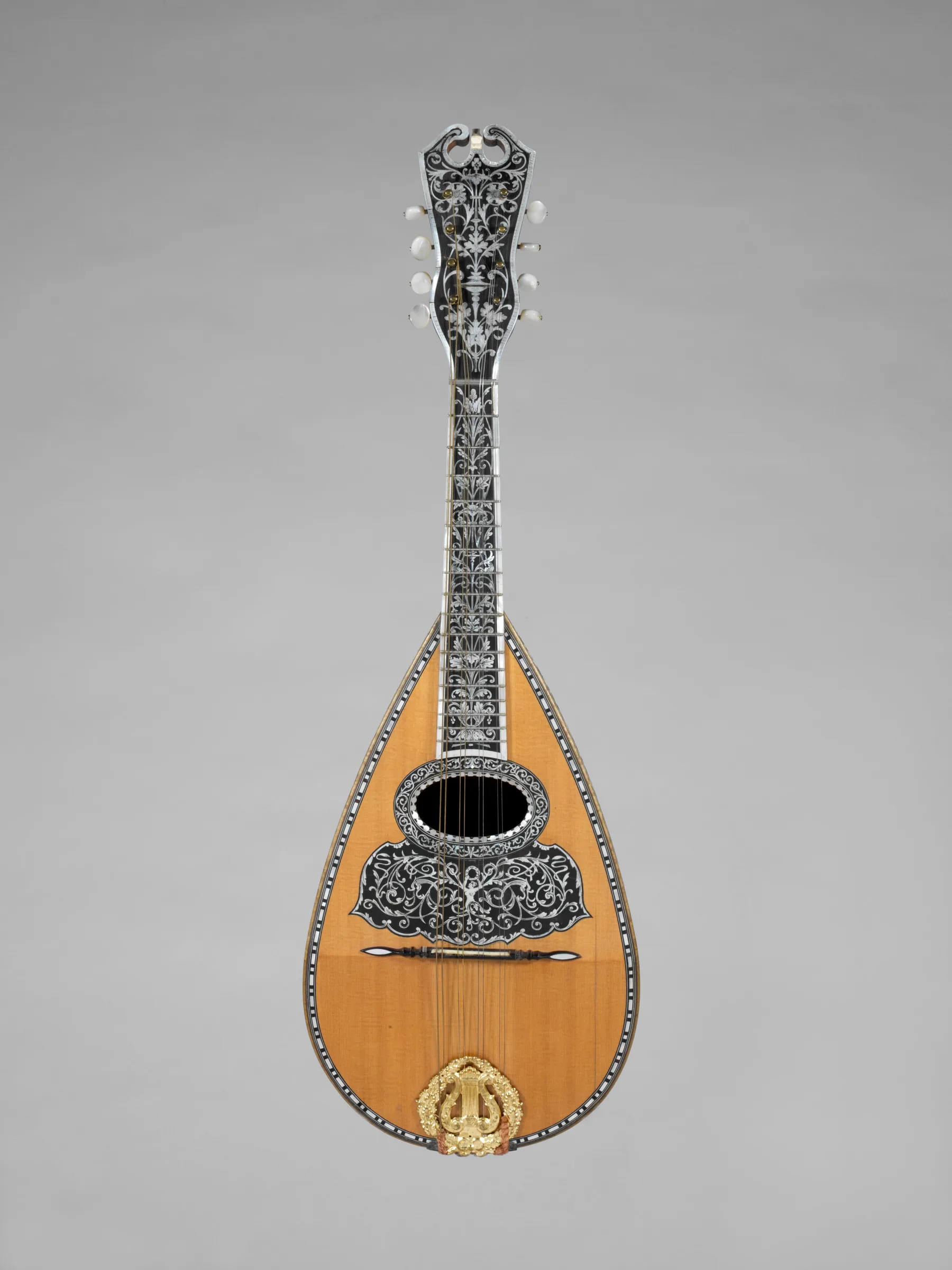
From the salon to large ensembles
During the golden age, music for plectrum ensembles flourished: duos, quartets and popular orchestras inspired an abundance of compositions. Transcriptions made it possible to play Bach’s Chaconne or works by Paganini adapted from guitar and violin repertoire.
In the twentieth century, the instrument’s distinctive color reappeared in symphonic works: Mahler (Symphonies Nos. 7 and 8), Stravinsky (Agon), Prokofiev (Romeo and Juliet), Schoenberg and Webern used it to enrich the orchestra.
“The mandolin has a unique voice: delicate yet projecting, it draws clear lines through the orchestral texture.”
To discover more about the instrument and its repertoire, see this page on the mandolin.
History of the mandolin: from Naples to bluegrass
A social and musical turning point came in 1878: the Estudiantina Española at the Paris Carnival gave the instrument wide visibility and renewed interest in the mandolin.
Its peak followed between 1880 and 1920 as it spread through Europe, the Americas and Japan. Plectrum ensembles and published scores multiplied, establishing a lasting international presence for the instrument.
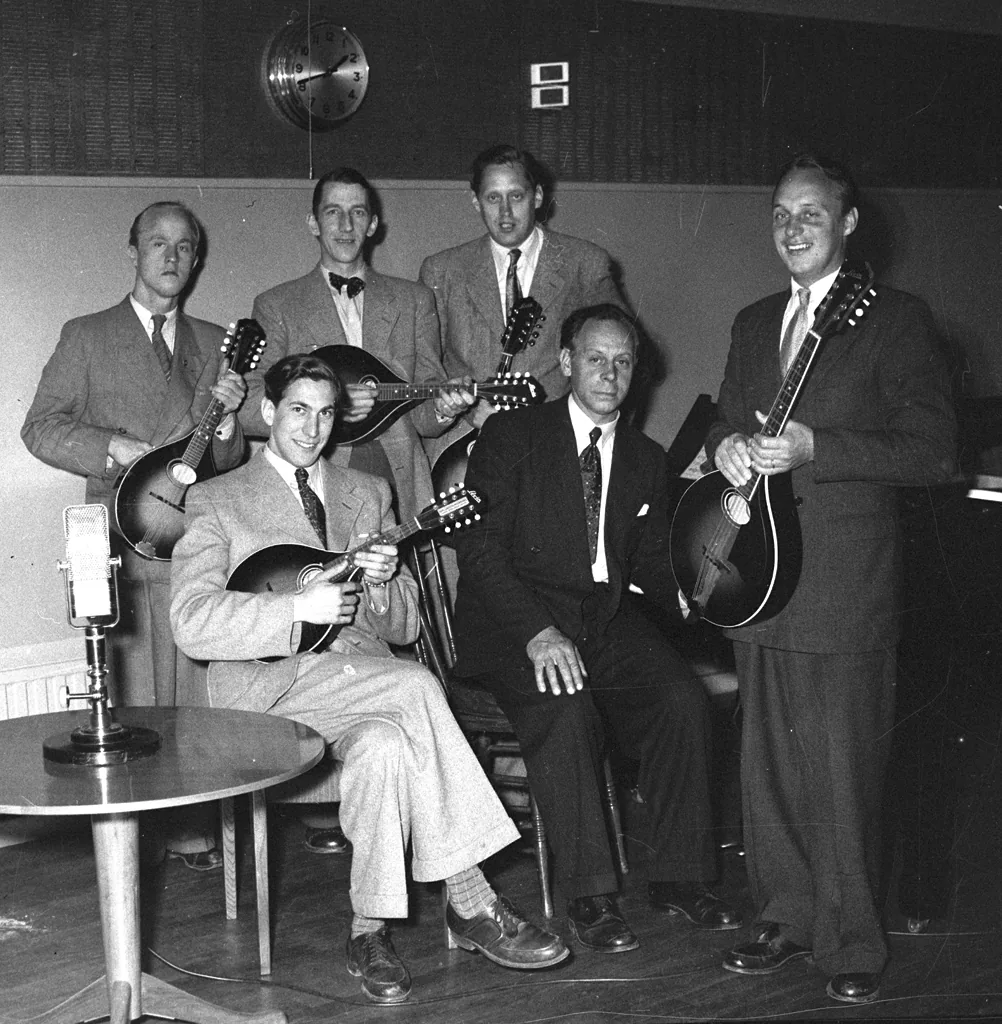
Decline, revival and playing today
In the twentieth century, competition from jazz and then the accordion contributed to a mid-century decline. Revival came in waves: bluegrass and country in the United States, modern jazz (David Grisman), rock and the Celtic revival brought the mandolin into new styles.
Festivals and instrument makers played a crucial role. Gatherings such as those in Lunel (2004–2014) brought together leading musicians and introduced the instrument to wider audiences. Contemporary makers—André Sakellaridès, Murry Kuun, Tim Phillips, Arik Kerman, Richard Morgan and Philippe Berne—have pushed the boundaries of construction and ergonomics.
Plectrum orchestras, particularly in Germany and Japan, along with recordings and digital media, pass the tradition between generations. For technical details and restoration work, see this Neapolitan mandolin restoration.
Bluegrass and American instrument making: the Gibson revolution
In the United States, Orville Gibson transformed construction by carving arched soundboards and backs inspired by the violin. He filed several patents in the late nineteenth century and founded Gibson in 1902, beginning production that changed the instrument’s sound.
Orville Gibson, A and F shapes, f-holes and the adjustable bridge
A break with earlier construction: carved soundboards and backs, f-holes and an adjustable bridge increase projection and sustain.
The A shape (pear-shaped) and F shape (with a scroll) optimize attack and sound dispersion. Gibson later expanded the family with the A4 (1921), F-4 (1920), H-2 (1917), K-4 (1924) and mandobass (1929).
Country and bluegrass styles, artists and playing techniques
On stage, these mandolins provide the power needed for country and bluegrass. They meet the demands of musicians such as Bill Monroe and, later, Ricky Skaggs and Chris Thile.
Key techniques include the rhythmic chop to mark the beat, crosspicking for fast arpeggios and expressive tremolo for solos. The arrival of electric models expanded the possibilities for amplification and effects.
| Element | Gibson feature | Advantage |
|---|---|---|
| Soundboard and back | Arched and carved | Greater power and sustain |
| Sound openings | F-holes | Clearer harmonics |
| Shape | A (pear-shaped) and F (scroll) | A: versatility; F: projection |
| Bridge | Adjustable | Better intonation and easier adjustment for different strings |
Practical advice: choose an F model for solos and projection, or an A model for rhythmic balance and a tighter budget. Its connection to the archtop guitar and its violin-inspired design have made this approach influential worldwide.
Conclusion
Small in size but rich in repertoire, the mandolin has crossed centuries and shown a remarkable capacity to adapt.
A summary of the journey: from medieval and Baroque roots to the Neapolitan model, then to American innovations and bluegrass. Tuning in fifths opens up a wide repertoire and makes transcriptions easier.
The soundboard and shape (round soundhole or f-holes) sculpt the tone, while the paired strings produce its characteristic singing tremolo.
Explore variants from around the world—Milanese, bandolim, Irish and snitra—and consider the names of different models (Neapolitan and Gibson A and F) as you make your choice.
Finally, listen to recordings and practice the plectrum, alternate picking and tremolo. This instrument remains both a part of musical heritage and thoroughly contemporary, continuing to inspire.